
Welcome to the inaugural issue of Desert HOA Insider. My goal is simple: provide Arizona developers and community leaders with the zero-fluff, tactical resources you need to streamline massive HOA operations. I want this to be a collaborative space, so if there is a specific operational headache you want me to tackle in our next issue, drop it in the comments or shoot me a message. Let’s get right into it.
The Reality Check
Whether you are a developer managing the declarant control phase or a volunteer board member inheriting a massive master-planned community, I’ve seen the same exact bottleneck in the Valley: well-intentioned leaders getting run ragged by vendor management issues.
You didn’t enter real estate to become a full-time supervisor for landscapers or a forensic accountant for roofing contractors. Right now, Arizona is facing massive vendor labor shortages and rising material costs. If your community is operating without strict vendor oversight, you are losing thousands of dollars and hundreds of hours.
The Maricopa County Vendor Vetting Checklist
To protect your bottom line and your time, you need a structured vetting system. Protect your association with these five essential steps:
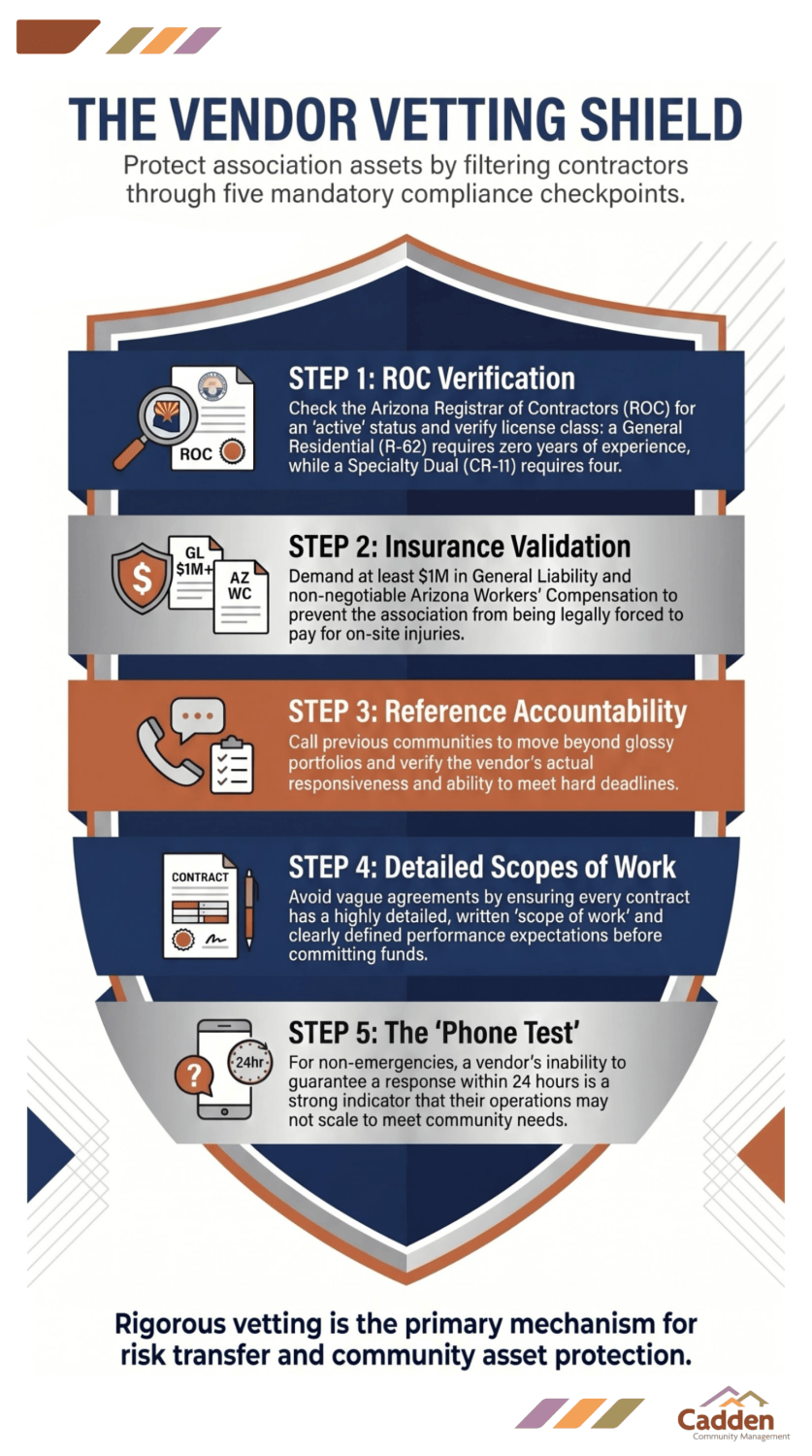
Step 1: ROC Verification.
Never take a vendor’s word for it. Check the Arizona Registrar of Contractors (ROC) for an “active” status. But look closer: a General Residential (R-62) license requires zero years of experience. Don’t hire a novice for a complex HOA project. Compare that to a Specialty Dual (CR-11) license, which requires four years of proven expertise.
Step 2: Insurance Validation.
Demand at least $1M per occurrence in General Liability. Most importantly, Arizona Workers’ Compensation is non-negotiable. If a crew member gets hurt on your common areas and the vendor is uninsured, your association is legally forced to pick up the tab.
Step 3: Reference Accountability.
Don’t just look at a glossy portfolio. Call previous communities. Ask specifically about their responsiveness and their actual ability to meet hard deadlines.
Step 4: Detailed Scopes of Work.
Avoid vague agreements. Ensure every contract has a highly detailed, written “scope of work” and clearly defined performance expectations before a single dollar is committed.
Step 5: The “Phone Test.”
For non-emergencies, if a vendor cannot guarantee a response within 24 hours, it is a strong indicator that their operations may not scale to meet your community’s needs.
The Automated Advantage
Accountability isn’t a people problem—it’s a system problem. When you rely on volunteers or busy site managers to manually track missing insurance certificates or expired licenses, communication breaks down and financial risk increases.
At Cadden, we don’t expect our developers or board members to act as compliance auditors. That’s why we mandate the use of VIVE (Vendor Information Verification Experts) to completely automate our vendor credentialing process.
Before a vendor ever steps foot on a Cadden-managed property, VIVE rigorously screens their Arizona ROC status, continuously monitors their insurance and workers’ comp for lapses, and ensures they meet strict financial requirements. Whether we are partnering with builders to transition a property or helping an established board, we ensure your vendors are thoroughly vetted, fully compliant, and held to the highest standard.